
Need assistance?

Why Swimming and Autism Fit Together: How Water Can Become a Sanctuary, a Skill Builder, and a Source of Strength for Autistic Teens

Brooks is a fictional composite based on experiences described by autistic swimmers and their families. For this thirteen-year-old, the moment he dives into the pool, the world above the surface seems to disappear. The noise, the confusion, the pressure — all replaced by rhythm and calm. Underwater, he’s free. The strokes are predictable, the sounds are muted, and the water feels like a gentle hug. For Brooks, who is autistic, swimming isn’t just exercise; it’s peace.

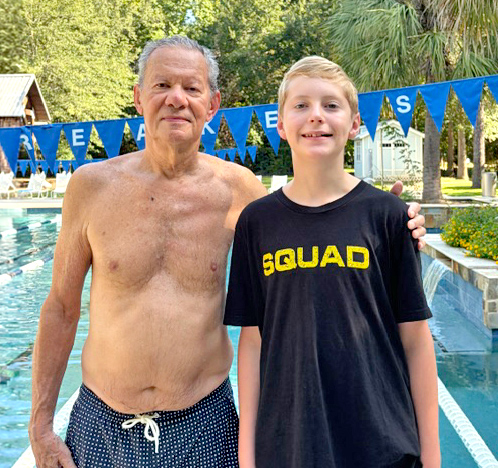
Ronald B. Smith, the article’s author, with Hendrix Keitt, the student he has been teaching to swim.
For some autistic children and teens, the swimming pool can be more than a place to exercise — it becomes a place where the world feels more predictable and manageable. On land, life can feel unpredictable, loud, socially complicated, and full of sensory surprises. But for some swimmers, being in the water changes the experience dramatically. The pool offers calm, rhythm, structure, and a kind of sensory clarity that autistic teens rarely experience anywhere else.
Swimming is one of the few sports where autistic characteristics that may create challenges elsewhere can become strengths. Repetition becomes mastery. Focus becomes endurance. Pattern recognition becomes technique. Routine becomes confidence. The pool can become a sanctuary where some autistic teens experience physical, emotional, and social benefits — not because swimming “fixes” autism, but because it changes what becomes possible. Recent research suggests that aquatic exercise may improve overall autism-related symptoms and behaviors, although evidence for specific motor and physical outcomes remains limited (Xin et al., 2026).
The Sensory Magic of Water
To understand why swimming can be such a good match for some autistic teens, start with the sensory experience of water itself. The pool can provide a sensory environment that, for some autistic swimmers, feels predictable, soothing, and deeply regulating.
Water exerts pressure on the body from all directions, and for some autistic swimmers, that hydrostatic pressure may provide a comforting sense of physical containment and body awareness, almost like a hug. Research has found relationships between sensory characteristics and water competency among children on the autism spectrum (Kemp et al., 2024), and aquatic environments have also been studied for their potential to support relaxation and sensory regulation.
Buoyancy offers a different kind of freedom. On land, movement can feel heavy, awkward, or overwhelming; in water, the body becomes lighter, joints relax, and movements flow. For teens who experience challenges with coordination on land, that lightness can make movement feel easier and more natural. Meanwhile, the rhythm inherent to swimming — the strokes, breaths, kicks, and turns — may help some autistic swimmers maintain attention, regulate arousal, and manage stress. Taken together, these qualities mean swimming can offer a fundamentally different sensory environment from most land-based activities. For autistic teens who experience sensory overload elsewhere, the pool becomes a place where their senses finally feel organized.
How Swimming Aligns With Autistic Thinking
Swimming doesn’t just offer sensory benefits; it can also align well with learning preferences that some autistic teens have. The sport is built on repetition: laps, drills, sets, intervals. What some athletes find monotonous, some autistic teens find reassuring. Stroke mechanics follow predictable patterns, and the attention to detail that some autistic teens bring can support the development of strong techniques. Because some autistic athletes can sustain intense focus on activities that interest them, that same deep concentration can translate directly into better pacing, technique, and consistency in the water.
Structure matters too. Swimming practices follow a predictable rhythm: warm-up, drills, main set, cool-down. That consistency builds confidence and reduces anxiety, especially for teens who struggle with transitions or unpredictability. And because many autistic teens are strongly motivated by personal improvement and mastery rather than external competition, swimming rewards exactly that kind of internal drive. Progress is measurable, personal, and deeply satisfying — and over time, that internal motivation becomes visible progress.
Every Autistic Swimmer Is Different
There is no single autistic swimming profile. Some swimmers compete independently; others need coaching adaptations or one-on-one support. Some simply enjoy recreational swimming, while others may dislike water altogether. Some autistic teens become competitive swimmers; others find the pool overwhelming. Some love the pressure and predictability of water; others are highly sensitive to its temperature, texture, sounds, or smell. The goal isn’t to make autism fit swimming. It’s to find the conditions under which an individual swimmer can thrive.
The Social Landscape: Belonging Without Overwhelm
Swimming offers a social environment that can be particularly comfortable for some autistic teens. Unlike many team sports, swimming allows athletes to train together while much of the actual performance remains individual, creating a sense of belonging without constant social pressure. Communication tends to be structured around sets, intervals, and instructions, and social expectations are often clearer than in team sports. Friendships form slowly and naturally, teens can participate at their own comfort level, and the pool deck itself offers predictable routines and roles. For some autistic teens, swimming becomes one of the few places where they feel both included and comfortable.
Coaching Strategies That Unlock Potential
Coaches who understand autistic communication styles may discover that some autistic swimmers bring exceptional discipline, focus, and commitment to improvement. The most effective approaches tend to share a few common threads: visual demonstrations paired with clear, concise instructions; predictable practice routines within sensory-aware environments; room for quiet focus; celebration of incremental progress; and avoiding sudden changes when possible. And most importantly, simply asking the swimmer what helps. When coaches recognize autistic strengths and adapt their communication and training environment accordingly, swimmers are often better positioned to develop both their skills and their confidence.
The Life Skills Swimming Builds
Beyond the pool itself, swimming can build skills that autistic teens carry into adulthood — emotional regulation, confidence, physical coordination, goal setting, stress management, independence, self-advocacy, and resilience among them. The pool becomes a place where autistic teens learn they are capable, strong, and adaptable — lessons that matter far beyond the water.
Conclusion: When Challenges Become Strengths
Swimming can provide enormous benefits, but water safety must remain the priority. Swimming ability does not make a child drown-proof. A 2026 systematic review (Muharib & Ramirez, 2026) found that structured interventions can improve swimming and water-safety skills among individuals with autism, while also emphasizing the need for continued research and appropriate instruction. Appropriate supervision, water-safety education, and individualized instruction remain essential for every autistic swimmer.
Swimming doesn’t “fix” autism. Instead, it can create an environment in which characteristics that may be challenging in one setting become genuine strengths in another. That is why swimming and autism can fit together so well — not because swimming changes the autistic swimmer, but because the right aquatic environment can change what becomes possible for that swimmer.
In the water, some autistic teens find calm, confidence, community, and a place where they truly thrive. As one coach told me, “The pool gives them what the world doesn’t: predictability, peace, and pride.” Swimming and autism fit together so well because the sport doesn’t fight the autistic brain, it matches it. And in that harmony, both swimmers and sport find something extraordinary: freedom.
“The water doesn’t change who an autistic swimmer is. It creates a place where swimmers can discover what they can become.”
Ronald Smith has over four decades of experience as a Senior PM/Program Manager. He retired from IBM having written four books and over one hundred articles on project management and the systems development life cycle (SDLC). He’s been a member of the Project Management Institute (PMI) since 1998, which has a membership of about 3 million professionals worldwide. From 2011 to 2017, Ronald was an Adjunct Professor for a Master of Science in Technology and taught PM courses at the University of Houston’s College of Technology. Teaching from his own book, Project Management Tools and Techniques – A Practical Guide, Ronald offers a unique perspective on project management that reflects his many years of experience. Besides writing, he swims five times a week to keep in shape. Lastly, in the Houston area, he has started up two Toastmasters clubs and does voluntary work at various food banks to help people facing hunger.
References
Xin, X., Guo, Y., Qi, Z., Liu, Q., Liu, L., & Ma, X. (2026). Effects of aquatic exercise on symptoms, behaviors, and motor function in children with autism spectrum disorder: A systematic review and meta-analysis. Frontiers in Behavioral Neuroscience, 20. https://doi.org/10.3389/fnbeh.2026.1927011.
Kemp, E., Nikahd, M., Ackerman, M., Howard, M., Darragh, A., & Crasta, J. (2024). Water competency and sensory processing among children on the autism spectrum. American Journal of Occupational Therapy, 78(6). https://doi.org/10.5014/ajot.2024.050750.
Muharib, R., & Ramirez, D. (2026). Teaching swimming and water safety skills to individuals with autism spectrum disorder: A systematic review. Review Journal of Autism and Developmental Disorders. https://doi.org/10.1007/s40489-026-00576-8.

Advertisement
