
Need assistance?

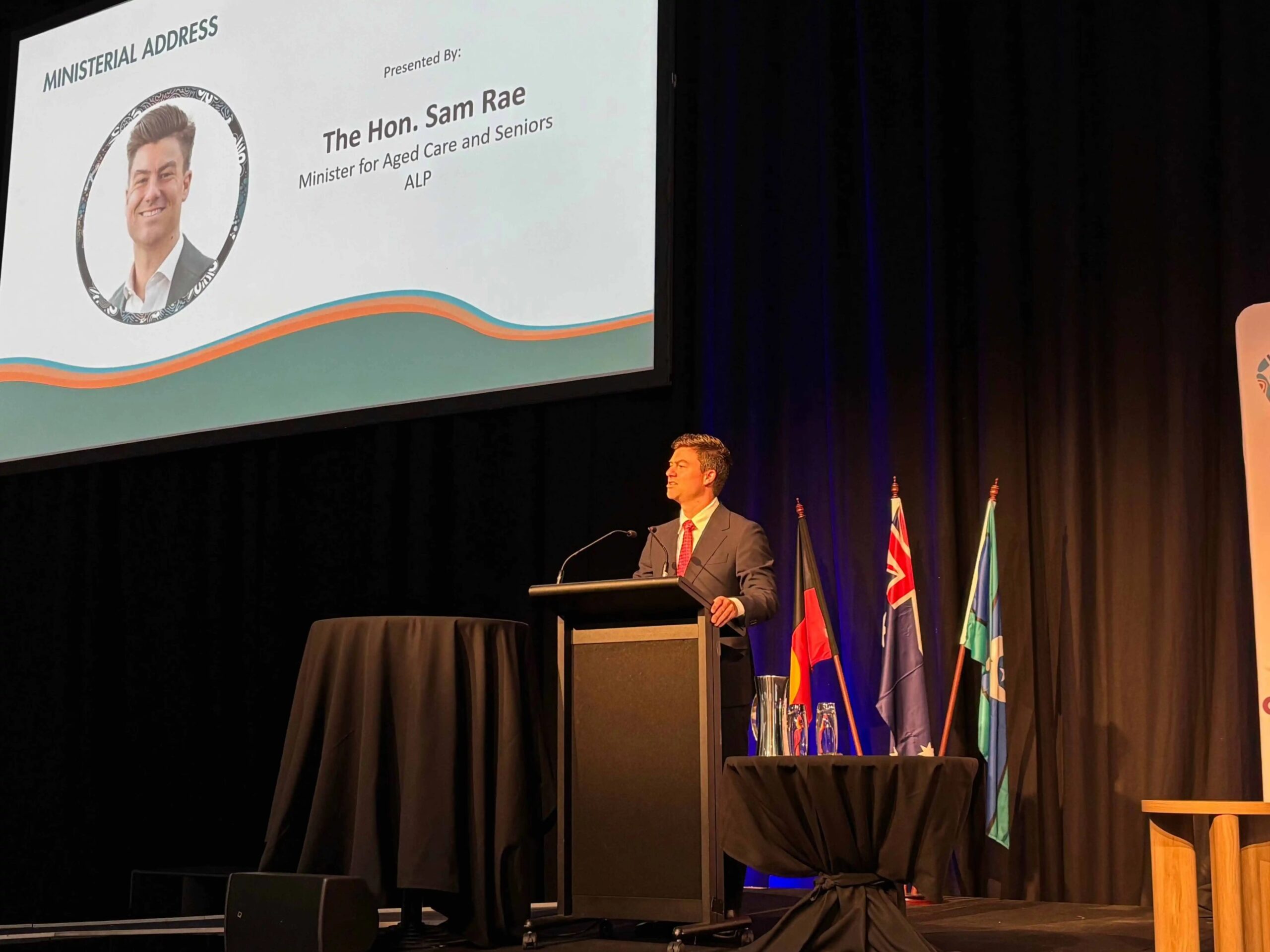

While there is a lot of good work happening in the aged care space for First Nations Elders and older people, there is still a lot that is not working, Minister for Aged Care and Seniors Sam Rae has acknowledged.
Appearing on day two of the inaugural National Aboriginal and Torres Strait Islander Ageing and Aged Care Council conference to deliver a ministerial address, Mr Rae said First Nations communities have been telling the government that things have not been working for a long time, and that this is something he has taken “very seriously”.

“Trust isn’t something that government gets to assume,” Mr Rae told delegates.
“For a lot of Elders, it was broken by policies that separated families and denied their rights.
“It gets rebuilt by what we do, not what we say, not what we promise, [but] the outcomes that actually get delivered and experienced by Elders across the community.”
Part of the work the government is doing in response to First Nations communities’ feedback is the establishment of an independent voice for Elders in the aged care system, Mr Rae said – pointing to the passing of the Aged Care Legislation Amendment (Aboriginal and Torres Strait Islander Aged Care Commissioner and Other Measures) Bill 2026.
Mr Rae acknowledged that there were differing views about where the role of the Aboriginal and Torres Strait Islander Aged Care Commissioner should sit.
But by having the commissioner based inside the independent Aged Care Quality and Safety Commission, the commissioner, like the ACQSC, is “not at the beck and call of government”, he said.
“We did that deliberately. It connects an independent First Nations voice directly to the leaders that regulate aged care. It means their advocacy doesn’t stop at advice. It has teeth, including powers to launch inquiries of their own accord and report publicly on what they hear from the community,” Mr Rae said.
“It will allow the Aboriginal and Torres Strait Islander Commissioner to harness the commission’s strong educative powers too, upskilling and supporting providers to deliver better care.
“And frankly it’s my strong preference that the money for this office is spent on getting support on the ground for providers, rather than the backroom roles like accounting, IT or HR that already exist within the commissioner structure.”
Govt recognises care can’t be all digital
But while a “strong voice at the top matters”, Mr Rae acknowledged that for most Elders, engagement with the aged care system is dependent on the first point of access.
“And you’ve told us that the door is too often a website, or a phone line, or a form that doesn’t make sense, that clear, easy to read information matters, and that digital isn’t always best,” Mr Rae said.
Recognising this, Mr Rae said the government knows there needs to be more models like the Elder Care Support pilot program – which provides services to support older First Nations people and their families and carers to understand aged care services, navigate assessments and choose a provider.
He said the government has also started working on culturally safe assessment processes with First Nations assessment organisations – so that trauma-aware and healing-informed assessments can be delivered.
Building NATSIFACP’s reach
The key question once a First Nations Elder or older person “is through the door” is whether the care that follows lets them stay close to family, community and Country or Island Home, Mr Rae said.
For Mr Rae, the National Aboriginal and Torres Strait Islander Flexible Aged Care Program is best positioned to deliver on this.
“When an Elder is cared for by an Aboriginal Community Controlled Organisation, they’re cared for by people who know their family, their language and their story. People who make room for Sorry Business, for ceremony and for going home. NATSIFACP is the best example we have of what that looks like in practice,” Mr Rae told delegates.
“It’s flexible, it’s community-led and it works in places that mainstream models just don’t reach. It funds the community to care for its own, rather than asking communities to bend themselves around a rigid program. It’s a very significant program, supporting organisations in every corner of our nation.
“But I feel the same way that you do about it. It’s not enough.”
Mr Rae was clear in his position on the NATSIFACP, telling delegates that he believes in it and that he wants to see it grow so that fewer people have to leave Country to access care.
“I don’t say that lightly. I’ll keep making that case until we can deliver upon that ambition,” he said.
Government wants to hear what is working
Mr Rae went on to encourage delegates to communicate to government what is working well and what is not, saying it is through feedback that they can measure the reform outcomes.
“So how will we know if any of this is working? Not by counting assessments completed or programs launched. That tells us that we’ve been busy, but it doesn’t tell us that people’s lives are yet better. The real test is outcomes,” he said.
“Is an Elder getting the care they need, close to family, in a way that feels safe? What about the older people who don’t show up in our numbers at all? The ones still waiting or who decided it was too hard? They obviously count too.
“That’s who I want us looking at when we decide whether this is working. And it’s why I keep coming to rooms like this and visiting your communities and meeting with you all to hear those stories firsthand.”
Whether the government has been measuring reform implementation rather than reform outcomes was a concern raised by NATSIAACC chief executive officer Kim Whiteley throughout the conference.
Support at home ‘broke the system’
It wasn’t long until Mr Rae got his wish for feedback, with the session immediately following his ministerial address being an open yarn session, where delegates were invited to share their experiences of how care is being delivered.
The message was clear: more funding is needed, and Aboriginal and Torres Strait Islander communities need to be better supported to deliver care to their Elders and older people themselves.
In particular, several delegates raised the issue of how few First Nations-run residential aged care facilities there are.

Support at Home was also raised during the open yarn, but assessments of it were blunt.
Lake Tyers Health and Children’s Services Elder home care supervisor Adrian Roberts told Mr Rae that “in many ways Support at Home broke the system for community.”
“It absolutely did. In terms of the shrinking of available supports under the program that started in 2023, Support at Home absolutely killed it,” he said, before describing how they have residents in the community who have got upwards of $200,000 in unspent funds that can’t be used for supports that would actually benefit them.
“I can’t get hard rubbish removed from their property. I can’t get the rats and mice out of their property. I can’t stop the mice running across this woman while she sleeps but she’s got $175,000 worth of unspent funds and that is disgusting,” Mr Roberts said.

Mr Roberts said that when they reached out to the Department of Health, Disability and Ageing for help, the response was to get in touch with the local ACCO.
“We are the ACCO and we don’t have a magic bucket of money to fix the things that are wrong,” he said.
“We’re grant-funded, the department knows that we’ve got funds for specific purposes. We can’t shuffle money from one side to the other to make things work. But this woman is unable to afford things herself, to rectify this situation for herself. She needs our support. But I can’t use Support at Home funding, it’s all out of the guidelines.
“So, as an ACCO, we fixed it. Of course we did. Because the dignity of that Elder, and the health of that Elder, is absolutely number one for us. But I think pressure gets put back on ACCOs all the time to operate in the grey areas and to just find a way to make stuff work when the rule book says it’s got to be a particular way.
“That’s what my community is saying to me: What’s the point of having this package if I can’t actually get what I need to live well at home?”
There were also calls for flexible funding models, including further investment in the Commonwealth Home Support Program, greater protections for First Nations Elders and older people against financial abuse, and for the removal of co-contributions for First Nations Elders and older people.
The Ageing Agenda is a media partner for the NATSIAACC conference. Read our coverage here.
Subscribe to The Ageing Agenda newsletters here and follow us on LinkedIn and Facebook

Advertisement

Comments are closed.