
Need assistance?

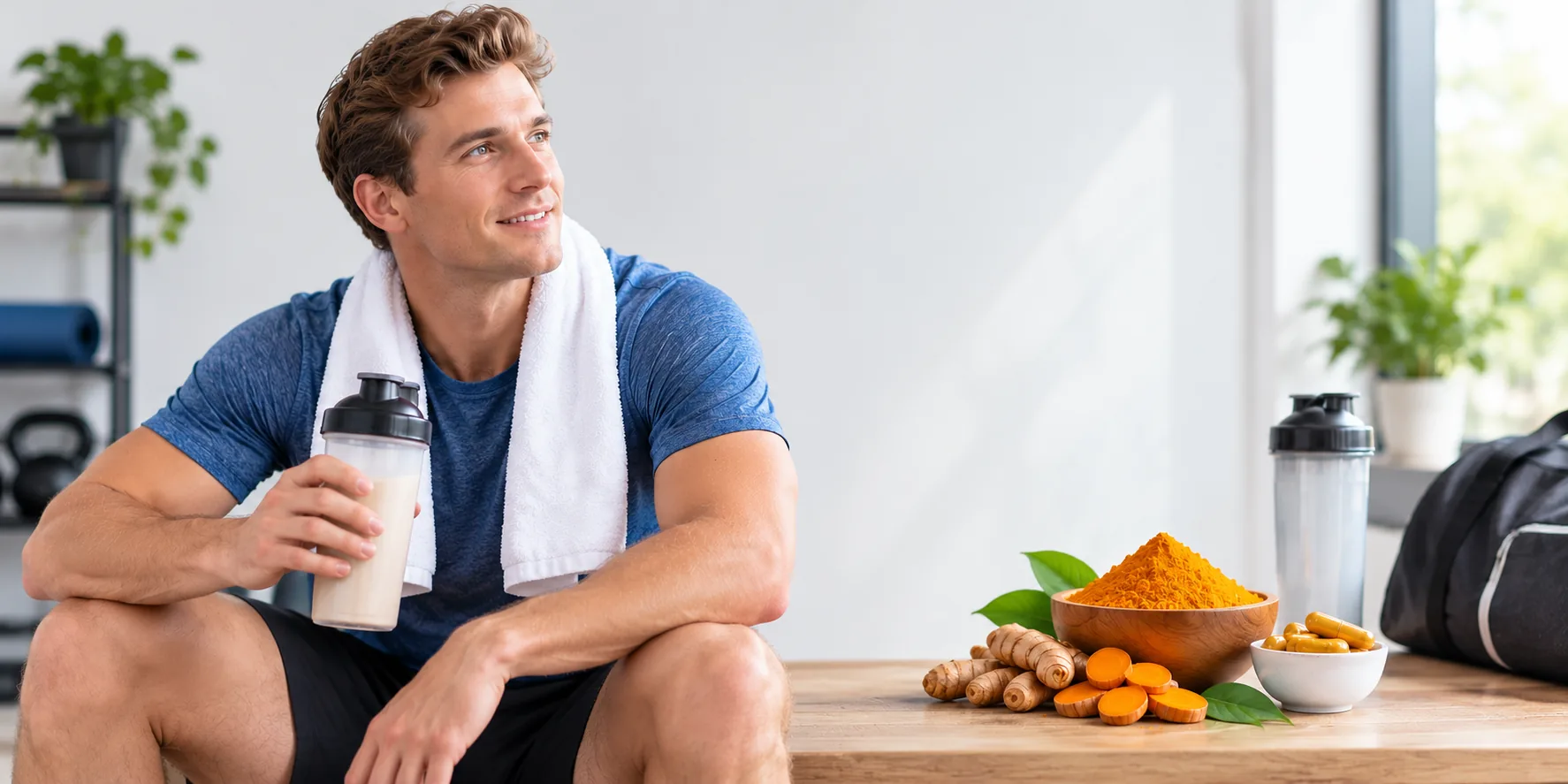


Curcumin is a natural compound found in turmeric. From golden lattes to curcumin supplements, more and more people are getting interested in curcumin, particularly with studies pointing towards its use for muscle recovery after exercise. Common belief is it helps with inflammation. We set out to find out whether curcumin for exercise recovery helps or the fitness industry is pushing towards wrong measurements. Here are our findings without the hype.
Curcumin and Exercise Recovery: How it Relates?
Inflammation is your body’s natural response to anything that causes stress, and exercise stresses your muscles, triggers inflammation. Curcumin is studied to work through many inflammatory pathways.
When you work out, you have sore muscles the next day that don’t let you push further. That may also be due to inflammation and that’s exactly why athletes are curious about using curcumin for muscle pain after exercise.
Let’s take a moment to understand the science behind why your muscles feel sore after exercise:
During sudden hard exercise, for example, while lowering a heavy weight or downhill running, your muscle cell membranes may tear microscopically. This is trauma. So, an enzyme called creatine kinase (CK) leaks out of muscle tissue into your bloodstream. High CK levels may indicate muscle damage. But CK levels vary for individuals and they do not directly measure recovery.
Your body starts an inflammatory response and sends signals to the muscle tissue. That’s how your body begins the repair. This muscle tear during exercise is what’s signaling your body to create stronger and bigger muscles. So, you need it. More muscle damage doesn’t equate to more muscles. These kinds of exercises may be causing you sore muscles called as delayed-onset muscle soreness (DOMS), which is the pain or discomfort you feel a few hours after the workout.
Curcumin is related to DOMS because it impacts these inflammatory pathways in your body. It may help with short-term muscle pain. But curcumin isn’t an off switch for your post-workout discomfort.

What Recent Evidence Shows About Curcumin for Muscle Recovery?
At Nutriessential, we check the scientific evidence.
In a 2024 meta analysis published in PLOS ONE, 14 randomized controlled trials were evaluated. The authors specifically studied curcumin supplements and exercise induced skeletal muscle damage. They had some interesting findings. Curcumin was found to reduce CK levels and inflammation (IL-6 marker) along with muscle soreness. Not only that, the authors also noticed enhancing range of motion (ROM). They said a low dose before exercise can be useful for muscle soreness, while taking it after works for CK and IL-6 markers.
A 2026 systematic review evaluated 15 randomized controlled trials from 2012 to 2026 to find out the effects of curcumin supplements on post-exercise recovery. It included athletes and active individuals. Findings show favorable outcomes in reducing oxidative stress and managing some measures of muscle damage and inflammation. But, overall evidence is low to very low. In these 15 trials, there are so many differences in who are studied, dosages studied, types of formulations, and what kind of exercise protocols were used. You can’t just make practical recommendations from this much variation.
So, does lower inflammation mean lower pain and better recovery? That’s not exactly right.
Are We Measuring the Wrong Thing with Curcumin for Post-Workout Recovery?
Curcumin may help reduce inflammation markers. But that blood marker report alone doesn’t mean you can squat better the next day without pain. The physical capability of doing exercise is different from what inflammatory markers show.
Your body needs acute inflammation. This may sound counterproductive, but it’s true. Forcing to reduce inflammation may not be helpful at all times. Your body needs the signal to repair to grow bigger, thicker, and stronger muscles. If you blunt that natural biological process all the time with high-dose antioxidants, you may not help your body’s natural adaptation. Antioxidant support may be useful for heavy and intense exercise routines.
Curcumin lowering inflammation is supported. But taking curcumin supplements without understanding dosage, timing, or safety is not the right way to improve exercise performance.

Dose, Timing, Bioavailability, and Long-Term Safety of Curcumin Supplements
The right dose and timing for you to take curcumin supplements can be guided by a healthcare professional. Discuss your intention of taking it for a longer duration. When you choose curcumin supplements, go for bioavailable forms.
-
Dosage: A 2025 study in Physiological Reports explains dosage importance. It investigated responses of hydrolyzed curcumin low dose(750 mg/day) and high dose (1500 mg/day) over 7 days on recovery after exercise-induced muscle damage in 34 recreationally active males. Both groups showed lower feeling of pain and improvements in muscle damage and oxidative stress markers. The high dose group showed greater effects. But, they didn’t find direct performance benefits with high dose. This is a small study and doesn’t establish general guidelines. Only your doctor can identify the right dosage for you.
-
Timing: In a 2026 research article in the Journal of Functional Foods, the authors studied delayed recovery and overtraining syndrome. They suggest matching dosage and forms with specific exercise-recovery windows. Talk to your doctor about when to include curcumin supplements in your gym routine.
-
Bioavailability: The natural curcumin form is not easy to absorb by your body. If you’re taking turmeric powders from grocery stores for curcumin benefits, you don’t know how much active compound it contains. In this 2026 paper, Yan Li argues using synthesized data that modern formulations like Thermacurmin®, CurcuFresh®, Meriva®, and Longvida® are designed to improve stability and absorption. Different curcumin supplement brands use different formulations to boost the bioavailability of the compound. Look at the product-based evidence to see if it matches the outcome you want.
-
Safety: Safety profile is studied at low doses. But in high doses and prolonged exposure there could be side effects. Consult with your doctor to find out if curcumin supplements are right for you.
If you are considering curcumin supplements for exercise recovery, first identify what outcome you expect. Existing evidence shows curcumin may support some recovery-related measures, but doesn’t directly show that it supports improvements in exercise performance. Discuss with your healthcare provider about the possibility of including curcumin supplements.
Takeaway
You exercise and expect muscle performance and strength to improve. To continue working out, you want to recover faster and feel less muscle pain so that you can go to the gym the next day. For athletes, this necessity is even stronger. They don’t want to miss training days. Curcumin supplements aren’t a replacement for the right exercise protocol, balanced nutrition, hydration, sleep, rest, and recovery. If you choose to include curcumin in your daily routine, go for high-quality supplements brands that provide bioavailable curcumin and evidence-backed formulations.
You can compare curcumin supplements from practitioner-grade brands at Nutriessential and buy them at competitive prices. All the supplements are sourced directly from manufacturers so you get authentic products. Contact the expert team for any additional questions.
Disclaimer: The information provided in this article, including all text, scientific study summaries, data analysis, and product mentions, is for educational and informational purposes only. Always seek the advice of your physician, registered dietitian, or another qualified healthcare provider with any questions you may have regarding a medical condition, dietary adjustments, or starting a supplement regimen.
-
Liu X, Lin L, Hu G (2024) Meta-analysis of the effect of curcumin supplementation on skeletal muscle damage status. PLoS ONE 19(7): e0299135. https://doi.org/10.1371/journal.pone.0299135 (source)
-
Lloret-Gil J, Victoria-Montesinos D, Martínez-Noguera FJ. Effects of Curcumin Supplementation on Exercise Recovery, Oxidative Stress, Inflammation, Muscle Damage, and Performance in Exercise and Sport Contexts: A Systematic Review. Nutrients. 2026 Jun 19;18(12):1992. doi: 10.3390/nu18121992. PMID: 42356379; PMCID: PMC13304679 (source)
-
Helder TA, Condon S, Grant I, Lewis NA, Hill J, Pedlar CR, Hughes L. The dose-response effects of hydrolyzed curcumin on recovery, inflammation, and oxidative stress following exercise-induced muscle damage in males. Physiol Rep. 2025 Aug;13(15):e70504. doi: 10.14814/phy2.70504. PMID: 40781899; PMCID: PMC12334844 (source)
-
Senlin Lei, Shuyue Deng, Ruolan Shi, Yifu Ding, Xiaoan Chen, Xianhui Li, Curcumin as a multi-target nutritional intervention alleviates exercise-induced injuries from overtraining: intervention efficacy and mechanism of action, Journal of Functional Foods, Volume 137, 2026, 107166, ISSN 1756-4646, https://doi.org/10.1016/j.jff.2026.107166 (source)
-
Li Y. Curcumin as a Natural Therapeutic Agent in Exercise-Induced Muscle Injury and Recovery. Natural Product Communications. 2025;20(9). doi:10.1177/1934578X251383097 (source)
You May Also Like:
The Athlete Who Trains Hard but Can’t Digest Their Nutrition Plan
Beyond Fuel: Understanding the Real-Life Challenges That Affect Athletic Performance
Why Athletes Stop Trusting Supplements and How Transparency Can Rebuild Confidence
Evidence-Based Sports Nutrition for High-Performance Athletes
The New Sports Nutrition Consumer Doesn’t Want Muscle. They Want Sustainable Energy

Advertisement
