
Need assistance?



A hot bedroom can make it hard to fall asleep. It also can make it harder to stay asleep and feel rested the next day.
As the climate warms, hot nights are becoming more common. Researchers are finding that rising nighttime temperatures can cost people sleep.
Sleep depends in part on your body’s ability to cool down. Before and during sleep, your body temperature naturally drops. When the air around you stays too warm, that cooling process can be disrupted.
Hot nights can add up
A recent Climate Central analysis estimated that high nighttime temperatures globally caused the average person to lose nearly 56 hours of sleep each year from 2020 to 2025.
In the United States, the analysis found that people in 253 cities lost an average of 36 hours of sleep each year because of high nighttime temperatures. According to the report, the U.S. cities with the largest climate change-linked sleep losses (between seven and nine hours per year) were in Arizona, California, Florida, and Nevada.
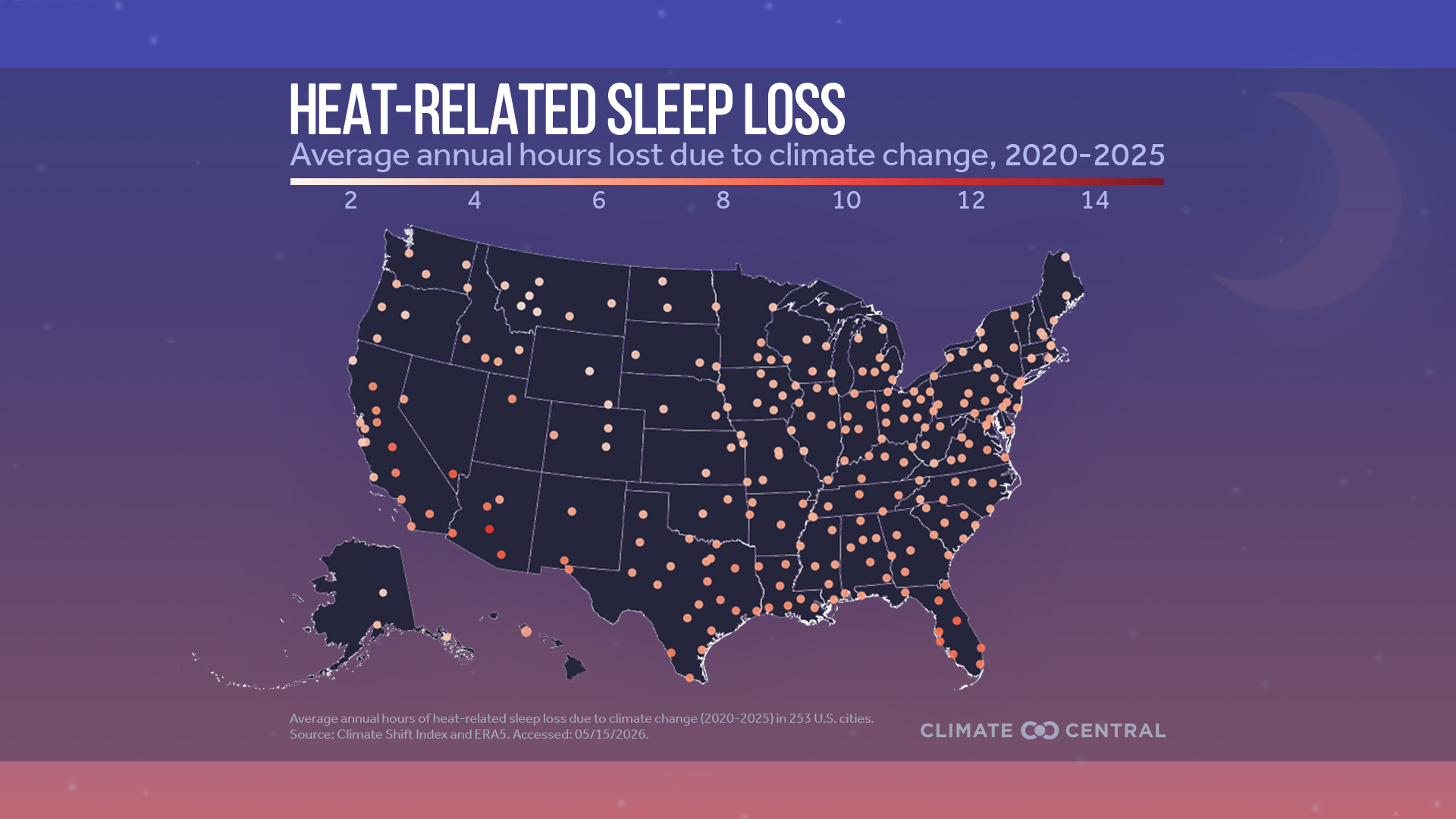
Image: U.S. Heat-Related Sleep Loss (July 15, 2026) Source: https://www.climatecentral.org/climate-matters/climate-change-sleep-loss
The impact is not the same everywhere. Cities in already-hot areas had some of the highest sleep losses. That includes parts of the Middle East, southern India, Southeast Asia, and West Africa.
Across nearly every city analyzed, the amount of temperature-related sleep loss linked to climate change has at least doubled since the early 1970s.
Real-world experiences reflect these research findings. During a June 2026 heat wave in the United Kingdom, a YouGov poll found that 65% of adults struggled to sleep during the hot weather, and nearly half of those respondents reported losing three or more hours of sleep each night.
Why does heat make sleep harder?
Your body does not simply turn off at bedtime. Sleep begins as part of a process that includes a shift in body temperature. A global study published in One Earth linked more than 7 million sleep records with local weather data. The researchers found that warmer nights made it more likely that people would not get enough sleep. Adults fell asleep later and slept less on hot nights.
The study found that sleep dropped by about 14 minutes on very warm nights. These were nights when nighttime temperatures were above 86 degrees Fahrenheit. The study also found that temperatures above 77 degrees Fahrenheit increased the chance of getting less than seven hours of sleep.
Researchers also found little evidence that people naturally adapt to hotter nighttime temperatures over time, suggesting that sleep may remain vulnerable as nights continue to warm.
A few lost minutes may not sound like much, but poor sleep can build up over many hot nights. Over time, that can affect how you feel, think, and function during the day.
Who is most affected by hot nights?
Heat can affect anyone’s sleep. But some people may face a higher risk.
- Older adults
- People who live in hotter areas
- People who do not have reliable cooling at home
- People with lower incomes, who may have less access to air conditioning
- People who already have sleep problems
Climate Central notes that air conditioning can help during hot nights, but not everyone has access to internal home cooling options. Even with cooling, high temperatures can still make sleep harder.
Heat can affect the next day, too
Heat does more than make sleep uncomfortable. A PLOS Medicine study followed 44 young adults in the Boston area during a 2016 heat wave. Students in buildings without air conditioning had higher indoor temperatures. They also performed worse on tests of attention, processing speed, and working memory. The overall study findings showed deficits in cognitive function resulting from internal thermal conditions during heat waves.
The study was small and included only young adults, but the findings point to a practical concern: Heat can affect how people feel and function after a hot night.
How to sleep better on hot nights
You cannot control the weather. But you can take steps to make your bedroom more comfortable. The best environment for sleep is one that is cool, dark, and quiet.
- Keep your room cool. Use air conditioning or a fan if you have one and it is safe to use. Wear light, breathable sleep clothes. Choose bedding that can be adjusted during the night.
- Limit heat before bed. Avoid heavy exercise too close to bedtime. A hard workout can raise your body temperature and make it harder to cool down.
- Try a lukewarm shower. A lukewarm shower before bed may help your body release heat. Avoid very hot showers close to bedtime.
- Hydrate during the day. Drink enough water, especially during hot weather. Try not to drink too much right before bed if bathroom trips wake you up.
Learn more about healthy sleep habits.
When to get help
Everyone has a bad night of sleep from time to time. But ongoing sleep problems are not something to ignore.
Talk to your doctor if poor sleep continues, if you feel very sleepy during the day, or if sleep problems affect your health, work, school, or safety.
You also can get help from the sleep team at an AASM-accredited sleep center.
The bottom line
Climate change is making hot nights more common. That can make sleep harder. Keeping your bedroom cool and following healthy sleep habits may help you rest better during extreme heat.
If sleep problems do not improve, talk to your doctor. Healthy sleep is part of your overall health.
Medical review by Dionne Morgan, MBBS, FCCP
Related:

Advertisement
