
Need assistance?

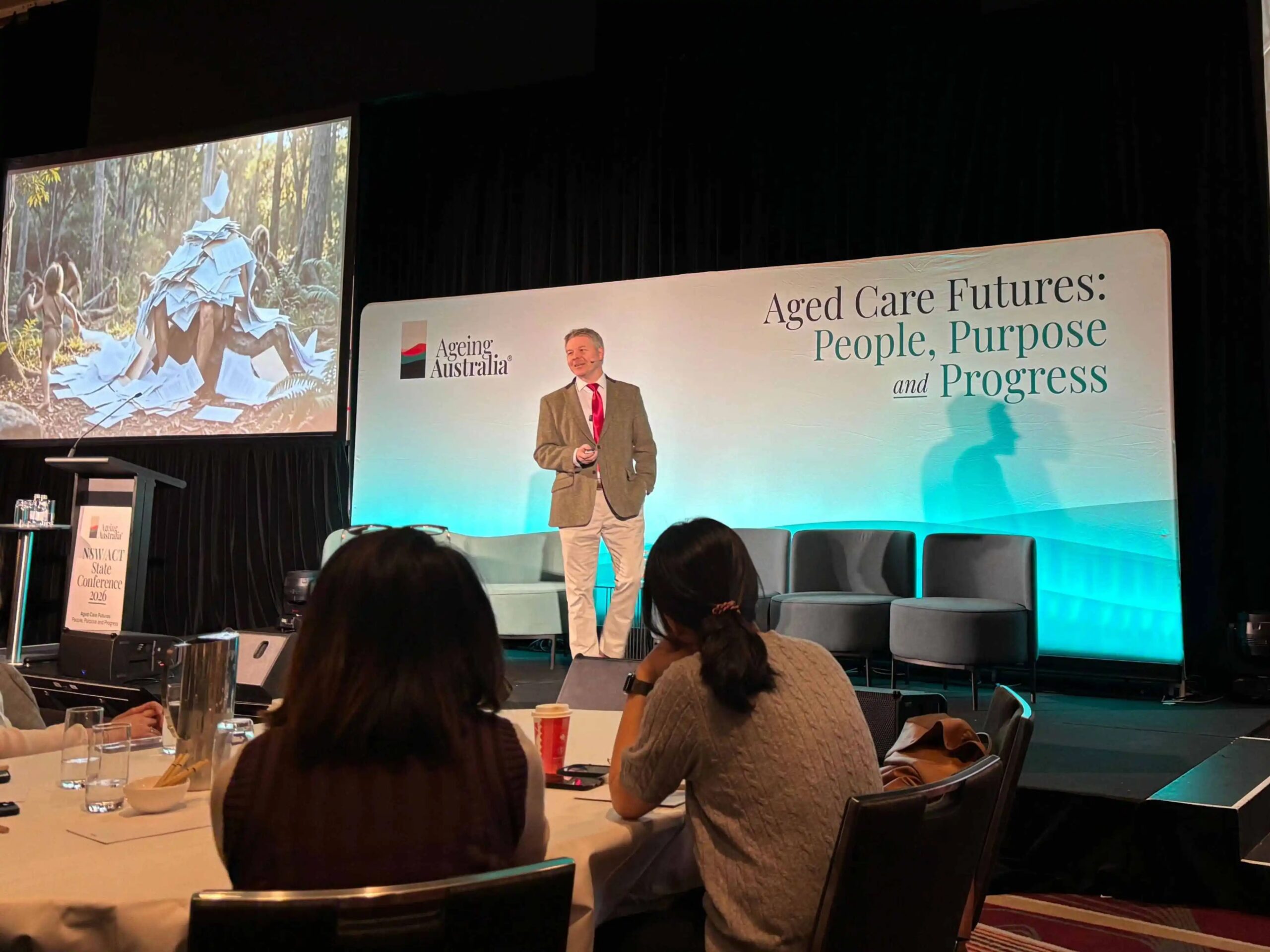

Workforce retention is a nationwide challenge for the aged care sector, but by listening more to the personalities of applicants during screening, providers can either refrain from hiring people unlikely to stay long-term or understand how to better support them.
This was a key message in ethyx Global founder and chief behavioural scientist Dr Darren Coppin’s keynote address on day two of the Ageing Australia NSW/ACT conference 2026 in Sydney on August 14.
By addressing inauthentic action during the recruitment process, Gold Coast-based aged care provider Feros Care was able to halve attrition, he said. Dr Coppin was brought in to address high turnover at Feros Care, and he told delegates that an important part of this is recognising and acting early when it comes to workers acting “inauthentically.”
Dr Coppin said they first got workers to conversationally engage with certain statements and indicate their level of agreement. The screening assessment took just three and a half minutes, but Dr Coppin said from the results they were able to show managers and human resources departments what level of commitment each applicant had.
“And we found that 21.2 per cent of applicants that did this three-and-a-half-minute assessment as part of their application were in what we call inauthentic action,” he said. “They’re saying all the right things, they’re doing all the right things [but] they have no genuine commitment, they have no genuine belief that they’ll perform well in that job.”

But he said they also uncovered several recruitment biases that were affecting retention, including recruiters being put off by confidence – despite this being a key message told to applicants.
Another bias was in response to applicants indicating that they do not like work that has to comply with government guidelines and processes – despite aged care being a highly regulated sector.
“Now, of course, we need people to deal with that. It’s absolutely essential for safeguarding our residents and our staff. But those people who answered that they agreed with that were recruited at 16.7 per cent above the base level. So people that disagree with that, we’re more likely to recruit them,” Dr Coppin told delegates.
“So you can start to see little things are contributing towards turnover. And that inauthentic action flag, the people that we could tell were wobbly, there was something not quite right and inconsistent in their application.
“Recruiters shortlisted from that group at exactly the same rate, but they were 5.5 times more likely to drop out of the interview stage and self-select and drop out. So we predicted it right up front with a quick answer to a question and they dropped out. Our care workers were there with no one to interview a lot of the time. We were able to halve attrition by addressing that and identifying people that were inauthentically acting straight away.”

Two kinds of empathy but one leads to burnout
The other major contributor to worker drop-out is burnout. Working in the care sector requires a huge amount of empathy every day and it’s often a person’s empathy that attracts them to the sector in the first place. But it’s also the sector’s biggest weakness, Dr Coppin said.
“We’ve known for more than 20 years now that mirror neurons exist. If you see something happening to somebody else, it happens physiologically in your own brain,” he told delegates. “If you see someone trip over, part of you will fling your hands up. We have jump scares from scary movies.
“If you’re dealing with somebody that has issues five times a day, five days a week, and you’re being empathetic with them, at the end of the week, you have issues. At the end of the day, we have coping strategies – you become antisocial, you binge-watch Netflix. This is how we cope with actually being empathetic.
“The greatest strength of our sector is actually demoralising us.”
There are two types of empathy, however:
- empathic distress – where you feel as somebody else, you feel with them and take on their suffering or discomfort
- empathic concern or compassion – you feel for somebody else but to some extent you are separate from it.
It is empathic distress that is burning out the aged care workforce, but Dr Coppin said people can be trained to shift their empathy to empathic concern (compassion).
“Compassion is a positive thing in our sector. But the problem was we couldn’t ask a survey of people ‘do you care for others,’ and then try and separate this out,” he said.
“We had to go for a story where people experienced certain situations because individuals game surveys. So we were able to determine who had certain types of empathy. And we didn’t say, ‘you’ve got bad empathy, that’s not you, we’re not recruiting you,’ we said ‘no, you’re a deeply connected individual, this is how you act, this is why people value you,’ and we were able to tell managers how to support those individuals if they took them on.
“Because quite often in our sector, we ain’t got a choice how many and which people we take on because we’re desperate for staff – we need someone in that role as soon as possible.”

It is often assumed the problem is recruitment and pre-assessment but the solution actually lies in supporting workers in the ways they need to retain them after hire, said Dr Coppin. He left delegates with five key learning points to help them do so:
- give certainty wherever you honestly can
- give autonomy wherever you cannot
- cut the sludge, it is the cheapest win you have
- nurture compassion, it is empathic distress that burns people out
- screen to save, applicants share who they are but providers aren’t listening.
Feros Care was able to save “a few hundred thousand dollars” in training and recruitment through these learnings and applicants were able to save months of doing a job that was going to burn them out, Dr Coppin said, but most importantly, the consistency of care was “hugely improved.”
Read more stories for executives here
Follow Australian Ageing Agenda on LinkedIn and Facebook, sign up to our twice-weekly newsletter and subscribe to AAA magazine for the complete aged care picture

Advertisement
