
Need assistance?

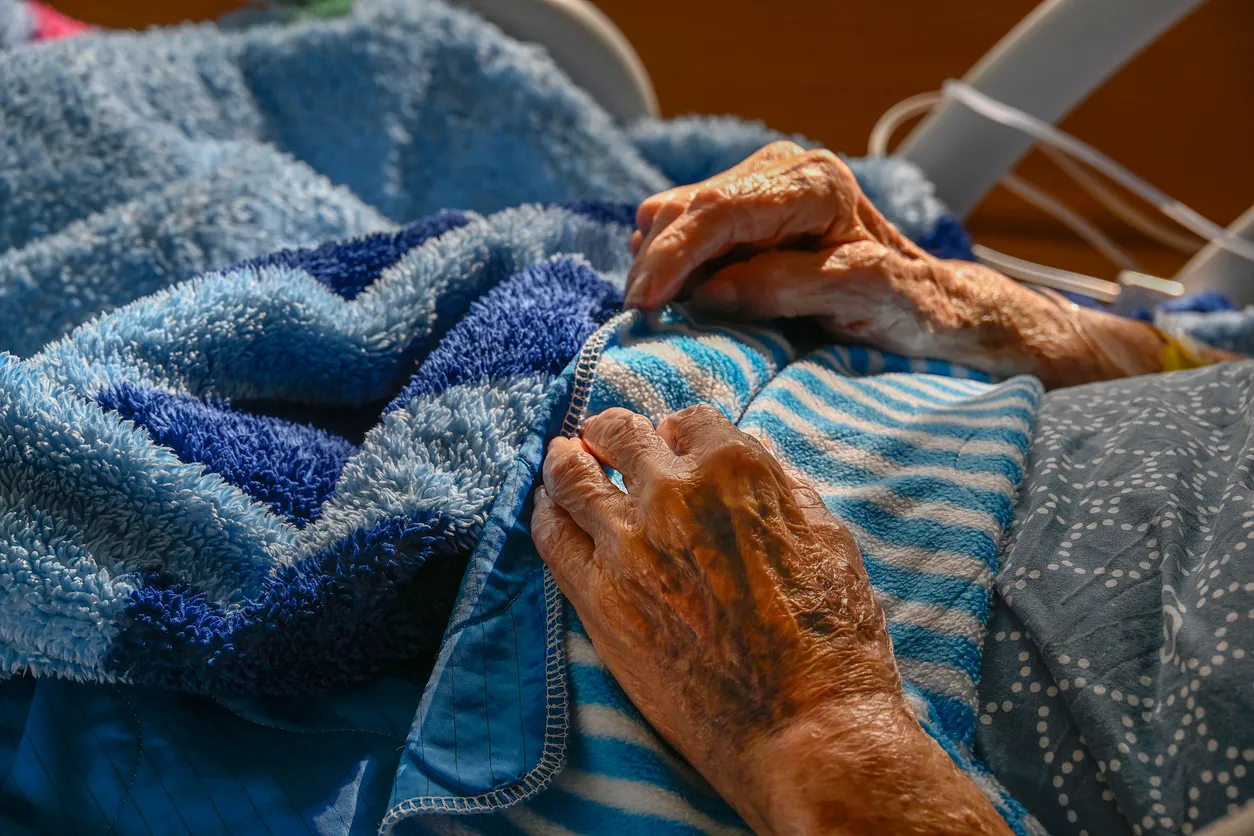

A palliative care nurse practitioner at Catholic Healthcare is investigating how routinely collected information can be used earlier to recognise care needs and help residential aged care staff plan ahead, improve communication and provide better support for residents and their families.
Flinders University student Lara McIntyre will lead the research project as part of her PhD, which is funded by Catholic Healthcare and a National Industry PhD Program grant worth $240,000 over four years.
McIntyre, a nurse practitioner and senior palliative care lead at Catholic Healthcare, says the study responds to end-of-life planning in aged care facilities often coming too late, despite the data to act sooner already being there.
“What I consistently see and hear is surprise. Surprise that someone has died in one of our homes. When I review our after-death audits, 2–7 per cent of residents die abruptly, which means 93–98 per cent of deaths are not abrupt – so therefore can be planned,” McIntyre tells Australian Ageing Agenda.
“We collect so much data on residents – clinical, lifestyle, personal – yet they are seen as separate data points and not put together to tell the story of a person,” she says.
“We have so many validated tools we can use and if we were just able to look at the data as a whole, as a story, we could get so much better at identifying the transitions and having those regular, vital conversations with families.”

Dr Priyanka Vandersman, McIntyre’s primary PhD supervisor at Flinders, says this project is about bringing data and service delivery together to answer an important question: how to provide quality care at the end of life for older Australians.
As nurses are the largest group of both direct care providers and digital health users in aged care, it’s natural this problem needs a nursing and digital health lens to solve, says Vandersman, a senior research fellow at Flinders University’s Research Centre for Palliative Care, Death and Dying and End of Life Directions for Aged Care (ELDAC) Project.
“Through my own work across nursing and digital health, I see how directly this ties to everyday practice. Nurses need to be part of asking the hard questions about digital and data solutions, because those questions are directly about how we support people to live and die well,” Vandersman tells AAA.
“We are already central to the care. We also need to be central to the digital solutions and opportunities around us, now and into the future, so our care processes keep improving and we can care well for the people relying on us.”

Professor Jennifer Tieman, McIntyre’s associate PhD supervisor at Flinders, says routine clinical data in aged care matters for the national palliative care agenda.
“The National Palliative Care Strategy 2018 highlights the importance of data and evidence in strengthening and improving palliative care. Data helps us understand if changes being made are effective and contribute to a robust evidence base for best practice,” she tells AAA.
“As the population ages, data about the needs and effectiveness of care approaches in different settings and for older people becomes more significant,” says Tieman, the Matthew Flinders Professor and director of RePaDD.
Mutual benefits of partnering
The National Industry PhD Program is part of the government’s Increase Workforce Mobility initiative and aims to train 1,300 PhD candidates in industry-research engagement over 10 years.
The Flinders-Catholic Healthcare project grant comes under the Industry Researcher PhD stream, which supports industry professionals to do a PhD while retaining their job and salary in industry.
Lana Richards, chief quality officer at Catholic Healthcare and McIntyre’s industry supervisor and manager, says the organisation chose to invest in this area because some questions are too important to leave unanswered until the evidence eventually catches up.
“As a provider, Catholic Healthcare sees the realities of care every day – the moments where clinical practice, consumer experience, family expectations and workforce capability intersect. Research gives us a disciplined way to test what we think we know, listen more deeply to older people and families, and build approaches that are grounded in evidence rather than assumption,” Richards tells AAA.
“For us, investing in research is not separate from care delivery; it is part of our responsibility to improve it for those in our care today and those in the future.”

Richards says the key to this type of collaboration is Catholic Healthcare being a partner in shaping the research question, and not just a site where data is collected.
“Being a genuine partner means helping define the problem, not simply opening our doors and providing access to older people once the research design has already been set,” Richards says.
“The best research in aged care is not done to providers or around older people; it is done with them. It combines academic rigour with the lived experience of care, the expertise of frontline teams, and the voices of older people and families.”
A transdisciplinary collaboration between a university and a large aged care provider aims to make possible what neither can do alone – joining forces to build on each other’s strengths rather than trying to do it separately, says Vandersman.
“The university brings rigorous research methods and the capability to build research capacity. Catholic Healthcare brings the problems that matter to the sector, and the ability to test solutions within the real constraints of aged care, not in a theoretical setting removed from it. Neither of us can do that well alone,” she says.
“There is also a sustainability angle because solutions built and tested this way are more likely to last and to work at scale. And it works both ways. The university learns from industry as much as industry learns from research. That bidirectional learning is part of what makes the partnership genuinely valuable, not just a funding arrangement.”
For the future of palliative care, Tieman adds that academic and industry partnerships offer a framework to explore complex issues with rigour and reality while creating meaningful outcomes and benefits for aged care and older people. Growing research capacity inside the aged care workforce matters as much as the findings themselves, she says.
“Aged care has been through a long and significant period of reform which has identified problems but also strengthened the sector. There is a growing understanding that the sector is unique with a challenging and demanding responsibility given our demography.
“The knowledge and skills embedded within the sector need to contribute to and drive their solutions and practices. Research and researchers will be key to developing answers and the aged care workforce is well positioned to be a core contributor to this research.”
Expected outcomes

For Catholic Healthcare, the ultimate goal is more consistent and relationship-centred end-of-life care that is closely aligned with what older people value most.
“We hope the findings will help us move from good intent to more consistent, evidence-informed end-of-life care,” says Richards.
“We want all people to have a good death and to live well until they die. That means being clearer about what excellent care looks like, how we recognise changing needs earlier, how we support families through difficult decisions, and how we equip our teams with the confidence, language and tools to respond well.”
Among McIntyre’s goals is to provide the aged care workforce with a process, or way, to read the “story” the person is telling.
“I want to give teams a time-saving means of sifting through the data and to be able to read the story. And in doing so, develop the confidence to regularly communicate and update families and residents,” McIntyre says.
“The ultimate aim, though, is to ensure those in our care receive high-quality care at the end of their lives and their families are protected from additional harm. The pain of having a loved one die does not need to be compounded by a poor experience or bad death. We get one chance to get it right – so with a little more information, we should be able to deliver every time.”
We hope you enjoyed this article – please add your comments below
Visit our features section for more in-depth stories

Advertisement
